

Last year, the abbreviation ZPEK – Western Fuel and Energy Company – appeared in the lexicon of the fuel market. From the second half of the year, it established itself in the TOP-10 diesel fuel importers, consistently importing over 30,000 tons per month.
Encor met with co-owner of ZPEK Oleg Chykyda, who is also the general director of this group of companies, to raise questions that are most often heard on the market, as well as those that concern all importers and wholesalers.
— The market heard about the ZPEK 2025 and started talking about it. But you started working with fuel earlier, how did it all begin? How did you end up in this business?
We entered the fuel business at a time of maximum crisis and great turbulence, caused by the war and the shortage of petroleum products in the country.
I've been in business since 2008, and before entering the oil industry, I had successful projects in several sectors, from forestry to construction. This means we entered the fuel market not from scratch, but with experience managing businesses, a team, and financial resources.
In 2022, when a fuel shortage occurred, it wasn't a question of whether to enter this business, but rather how quickly to scale up to secure our share. We saw a market where the monopoly of former suppliers disappeared, where import sources and supply chains changed. There was a desire and confidence that we could build a systemic business here.
Literally, it all started with one tanker truck. Partners from Lithuania, with whom we had worked before in other areas, approached us and offered the first batch of petroleum products. The team that was involved in chemistry was immediately reoriented to the fuel business: we obtained the necessary licenses for the «Khimzakhid» company.
Today, ZPEK is already a structured importer with its own logistics, infrastructure, financing, and scale. But I believe we are only at the beginning.
— It is known that for some time you worked at WOG, can you tell me more about this episode of labor geography...
WOG was my first job after graduating from university. Back then, in 2004, I witnessed a period of aggressive network expansion; the company managed the Halychyna oil refinery. There I gained my first experience and made my first contacts in this field. It was there that I met Volodymyr Tarysyuk, who was already one of the company's top managers. I won't hide the fact that 20 years later, those connections helped me quickly build a professional team and adapt to the market.
— Old-timers of the market know Mr. Tarasyuk well. At what stage did he join ZPEK?
The company had been around for about six months. That's when I realized that for growth, we needed a higher-caliber staff. I was certain that Volodymyr Mykolayovych, with his 23 years of experience, professionalism, and personal qualities, would strengthen our team. So, I called him, and we arranged a meeting that lasted 6 hours. Despite the lingering taste of his previous work in this field, I managed to convince him.
— Tell me, what happened in the summer of 2025? The first half of ZPEK was very mediocre, with seemingly no imports at all in January. But in the second half, there was a sharp rise with a record of over 40 thousand tons and maintaining high rates this year as well. What happened then?
ZPEK is not a story of sudden success; it's the result of three years of hard, daily work. We laid the foundation for future results, investing in fuel trucks, railway tank cars, and infrastructure. The company has gone from importing one fuel truck per week to its first train in September 2024, and now to five trains weekly.
In parallel, we expanded our cooperation with our partners - ORLEN, UNIMOT, VITOL, as well as with our strategic partner - Oktan-energy company.
So I wouldn't call it a sharp rise, but rather an evolutionary transition to a new level.
— You're relatively new to this market, so it's interesting to hear what surprises you about it. What has been the biggest surprise? What inspires you or disappoints you?
What surprised me most was the market itself – its lack of system, its chaos, and the positions of many companies that live «one day at a time.» When you enter the big business world, you expect clear rules of the game, logic, and predictable economic behavior from competitors. That's not here. Many decisions are made situationally, illogically, and not in favor of the business.
We often encounter incomprehensible dumping and chaotic competition, where buyers who are willing to pay millions to unknown parties for a discount of a few cents per liter. They get burned, come to us, but then are ready to take risks again.
It's surprising that systemic players in the oil market often resort to this, dumping prices and selling at a loss, just so that buyers don't work with ZPEK.
— Then another aspect is of interest. For example, in Poland, there are up to 10 importers, while in our country there are 120, and in 2023 there were hundreds. And there are systemic players, with oil depots, fuel trucks, and officially paid staff, and then there's Mykola with one fuel truck and a license for $100, who brings fuel and sells it cheaper right under the fence of the system operator's oil depot.
While system players are needed, and «Mykolas» have also shown themselves well in 2022-2023. ZPEK has gone from a conditional Mykola to a prominent wholesaler. How do you think the state should act to regulate the market?
In my opinion, the truth is somewhere in the middle. At the beginning of the war, in my conviction, the state did absolutely the right thing – it deregulated the market and allowed it to function. Cheap licenses, low VAT, and no excise duty, an expedited customs clearance at the border – all together allowed us to quickly solve the problem of shortages.
But the situation is different now. In my opinion, the state should already have more control over this market and impose stricter requirements on fuel importers. This is in the direct interest of the state because it concerns lost taxes, as the hypothetical Mykola often sells for cash. The absence of any obligations also creates fertile ground for fraudulent schemes that have harmed businesses. These include cases like «Continental Trade» and «Avikom Rivne»; there are many such cases in general.
There are still companies that buy a license for 16,000 UAH, operate for 3-4 months, run schemes with fuel, and then disappear, leaving problems for players like us. And then the tax authorities come to us and ask certain questions.
That's not all. Through schemes, they offer our product to our own customers at lower prices than we do. Then they disappear, and we earn nothing with such competition. Consequently, there's no resource for creating infrastructure, new jobs, a tax base, etc.
I don't know to what level, but the entry threshold to the market definitely needs to be raised. This could be high license fees, mandatory reserves, infrastructure availability, etc.
— Despite everything, ZPEK is developing – volumes are growing, you are investing in infrastructure. Everything requires money, especially with the current rise in quotations. How are you solving this problem?
We started with our own resources. Then we established working relationships with banks. Today, we are working with tens of millions of dollars and continue to expand our capabilities. For example, ZPEK has signed a memorandum with Ukrgasbank, which provides for increased financing for infrastructure projects and replenishment of working capital. For us, financing is not a matter of «survival,» but of business scaling.
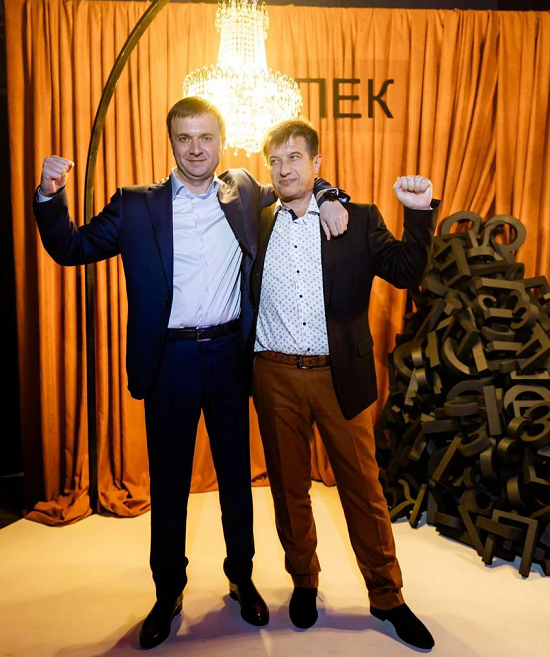
Oleg Chykyda and Volodymyr Tarasuyk
— You work a lot with the railway; you are one of the largest importers. What are the trickiest aspects here?
Currently, rail is the main route for our imports. The volumes are record-breaking, but the infrastructure we use, and not just us, has limited potential, and this is the main problem. We are trying to adapt to the realities and solve infrastructure problems through cooperation with elevator owners and by utilizing existing capacities.
The second problem is the interaction between «Ukrzaliznytsia» and its Polish counterparts. A train can stand on the Polish side for 5-6 days. Before the New Year, our trains were stuck from December 24th to January 2nd solely because practically no one was working on the Polish side.
— Why can't large companies that invest in terminals and refueling complexes build, in general, technologically simple railway transshipment facilities?
I don't think anyone fully understands how long massive rail supplies from Europe will last. Investments in such a terminal range from $5 million to $25 million. And no one understands how quickly that money will be recouped. After all, there's a risk that you'll build a terminal, the war will end, and it will stand empty.
Therefore, everyone is trying to temporarily solve the issue in some way – they are adapting elevators, doing something primitive for transfer.
— You recently traveled to Chop and Vadul-Siret—challenging and illiquid routes. Why?
We do not work piecemeal; we are building a systemic presence. Chop and Vadul-Siret are additional channels for importing petroleum products for us, which increase volumes and ensure ZPEK's presence in the market in these regions.
— The hardest winter is behind us. What was the most difficult for you?
This winter proved to be a serious stress test for the entire industry. We faced the freezing of the waters in the Port of Szczecin.
Our wagons derailed near Warsaw due to ice. Thank God, there were no casualties and no serious damage.
Physically, it was very difficult for our workers to work in the downpour at temperatures of minus 20-25 degrees. I am very grateful to them for this work.
There were surprises with the diesel fuel quality. The American fuel performed well, but some fuels froze, even though they weren't supposed to according to their documentation. However, we didn't have widespread complaints. On the contrary, our geographic reach expanded; in winter, people even came to us from Cherkasy, Dnipro, and Kremenchuk.
Due to the frost, there were significant shortfalls in the resource: the product still partially paraffins, freezes, and on large trains, losses of 20-25 tons could occur. That's a lot for us.
The winter was difficult for the country overall. We endured, and I am proud that we were a part of this struggle. We wanted to work, we felt the responsibility and importance of our work when the whole country was on generators.
In such conditions, it's not the strategy that's being tested, but the foundation of the business. We fulfilled all our obligations to clients despite weather conditions, logistical problems, and technical difficulties. For ZPEK, this is key – client trust. This is precisely what builds a long-term business.
— In closing, please share your impressions of spring, which has become another test for the market, and most importantly, for wholesale traders. How are you working through this?
Today the market is operating in daily force majeure.
The risks are immense, especially for wholesalers who will not be able to cover themselves with retail margins due to high volatility. The strain on working capital has increased.
This stage is going smoothly for ZPEK. The company has sufficient funding, confirmed contracts, and volumes. In March, we imported over 30 thousand tons. In April, we are continuing to increase volumes.